

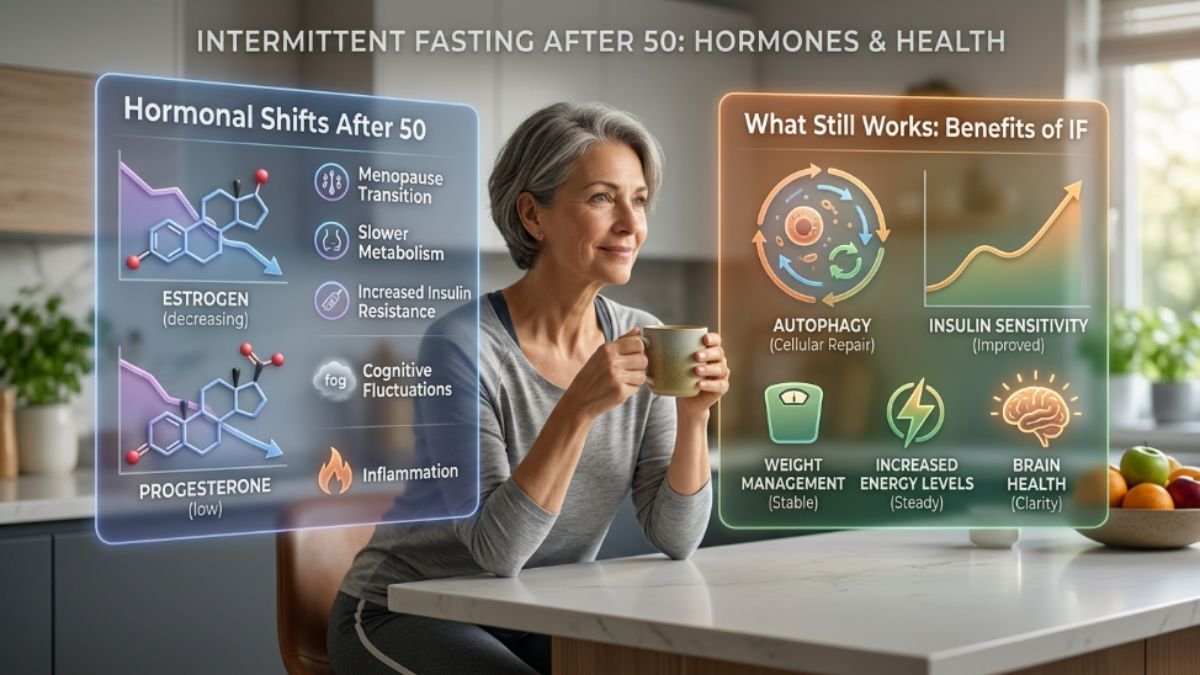
Intermittent Fasting After 50 Women Hormones: What Changes and What Still Works
Intermittent fasting after 50 women hormones hits differently for women — and if you’ve tried a protocol that worked beautifully for someone else and found it left you more exhausted, more irritable, and no lighter than before, you are not doing it wrong. You are experiencing a hormonal reality that most fasting guides never acknowledge.
The research on intermittent fasting is genuinely compelling. Reduced inflammation, improved insulin sensitivity, better metabolic flexibility — these outcomes are real and documented. But the majority of foundational studies were conducted on men or on younger women, and the hormonal environment of a woman over 50 responds to caloric restriction and fasting windows in ways that require a meaningfully different approach.
This is not a reason to avoid fasting. It is a reason to understand it precisely before you start.
Medical Disclaimer: This article is intended for informational and educational purposes only. It does not substitute professional medical advice, diagnosis, or treatment. Always consult a licensed healthcare provider before beginning any fasting protocol, especially if you manage a chronic condition, take prescription medications, or have a history of disordered eating.

The Hormonal Landscape After 50: Why Fasting Affects You Differently
To understand why standard fasting protocols often backfire for women over 50, you need a clear picture of what has shifted hormonally — and why those shifts matter for how the body responds to periods without food.
Estrogen, Cortisol, and the Stress Response
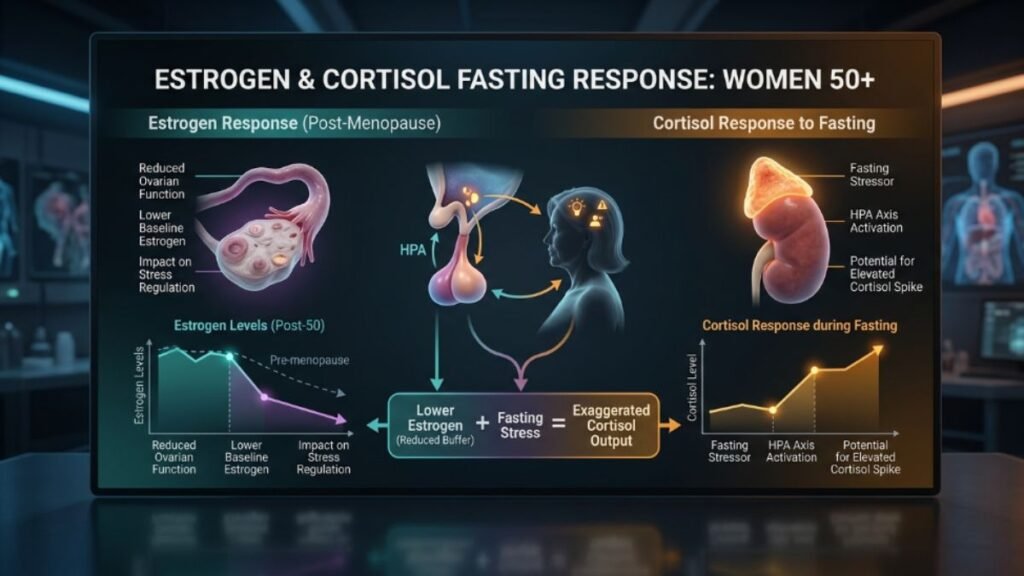
Estrogen has a buffering effect on cortisol. When estrogen levels are adequate, the body’s stress response is modulated — cortisol spikes are shorter and recover more efficiently. After menopause, that buffer diminishes significantly.
Fasting is a mild physiological stressor. For a younger woman with robust estrogen levels, a 16-hour fast triggers a manageable cortisol response that the body handles and recovers from quickly. For a post-menopausal woman with low estrogen, the same fast can produce a disproportionate cortisol spike — one that lingers, disrupts sleep, elevates fasting glucose the following morning, and paradoxically makes fat loss harder rather than easier.
This is the central irony that frustrates so many women over 50 who try fasting: they do everything right by the standard protocol and still feel worse, sleep worse, and see no meaningful change in body composition.
Blood sugar stability and metabolic rate are deeply connected — understanding what happens to your metabolism after 40 helps explain why glucose regulation becomes a different challenge entirely after menopause.
What Happens to Insulin Sensitivity After Menopause
According to research published by the National Institutes of Health, estrogen plays a direct role in maintaining insulin sensitivity at the cellular level. Its decline during menopause correlates with measurable increases in insulin resistance — independent of diet, exercise, or weight.
This matters for fasting because one of its primary benefits is improved insulin sensitivity. The mechanism works: fasting lowers circulating insulin, gives cells a recovery period, and over time improves their responsiveness. But in a hormonal environment already characterized by insulin resistance, the fasting window needs to be calibrated carefully — too aggressive, and you activate the cortisol pathway instead.
Thyroid Function and Caloric Restriction
Prolonged or overly aggressive fasting can suppress T3 — the active form of thyroid hormone — as the body interprets extended caloric restriction as a threat and downregulates metabolic rate in response. For women over 50, whose thyroid function is already more vulnerable to disruption, this is a meaningful risk.
The practical implication: fasting windows of 12–14 hours are meaningfully different from 18–20 hour windows for this population. The former works with the hormonal environment; the latter may work against it.
Which Fasting Protocols Actually Work After 50
Not all intermittent fasting approaches carry the same hormonal risk. The key variable is the length of the fasting window and when it falls relative to the body’s natural cortisol rhythm.
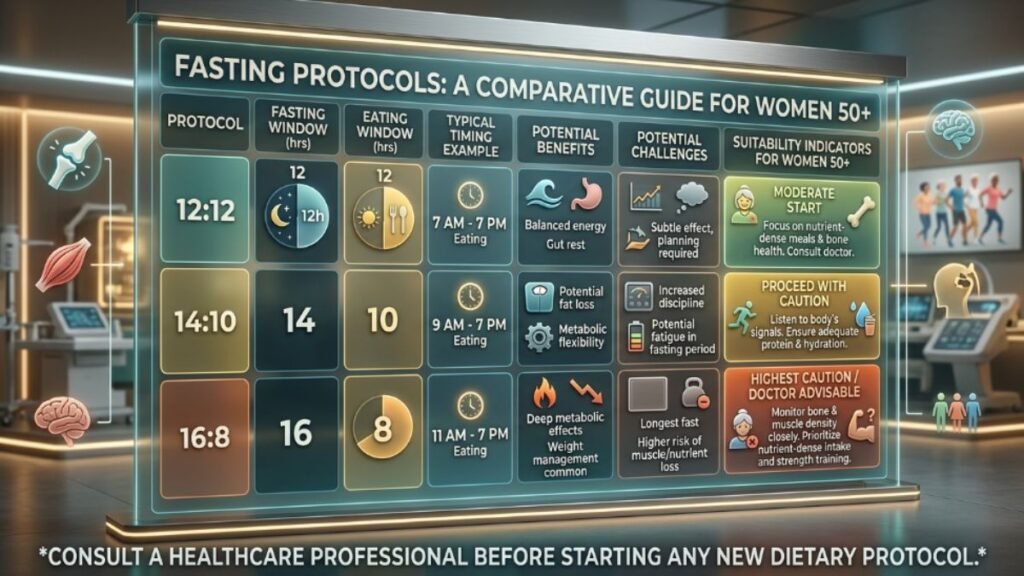
The 12:12 Method — The Safest Starting Point
A 12-hour fast — finishing dinner by 7pm and eating breakfast at 7am — is not dramatic by fasting standards, but for women over 50 it is often the most metabolically productive starting point. It is long enough to lower insulin and allow cellular repair processes to begin, but short enough to avoid the cortisol cascade that longer windows can trigger.
Many women report that 12:12, practiced consistently for 60–90 days, produces more sustainable results than immediately jumping to 16:8 — with significantly less disruption to sleep, mood, and energy.
The 14:10 Window — The Practical Middle Ground
Extending the fast to 14 hours — finishing by 6pm and eating at 8am — gives the body more time in the fat-burning zone without crossing into the stress-response territory that longer fasts can activate. This is the window most supported by emerging research specifically on post-menopausal women.
A study published in the journal Cell Metabolism found that time-restricted eating in a 10-hour window produced significant improvements in metabolic markers, body composition, and blood pressure in older adults — with minimal adverse hormonal effects.
The 16:8 Method — Proceed With Awareness
The 16:8 protocol — the most widely promoted fasting approach — is not inherently problematic for women over 50, but it requires more careful management. Specifically: breaking the fast with a protein-rich, low-glycemic first meal; avoiding the fast on consecutive days initially; and monitoring sleep quality and morning energy as indicators of whether the cortisol response is manageable.
If you notice consistently disrupted sleep, worsening morning fatigue, increased anxiety, or stalling weight loss after two to three weeks on 16:8, these are signals to shorten the window rather than push through.
The Eating Window Matters As Much As the Fasting Window
A detail that most fasting guides skip entirely: for women over 50, when you eat within your eating window has measurable effects on how the body processes glucose and manages cortisol.
Front-Loading Calories Earlier in the Day
Research consistently shows that consuming the majority of daily calories earlier — rather than in the evening — aligns better with circadian cortisol patterns and produces better metabolic outcomes. Cortisol is naturally highest in the morning, which corresponds with peak insulin sensitivity. Eating larger meals at this time works with the body’s rhythm rather than against it.
For a woman on a 14:10 protocol eating between 8am and 6pm, this means making lunch the largest meal of the day and keeping the evening meal lighter — not necessarily smaller in overall daily calories, but redistributed toward the morning hours.
Breaking the Fast: What You Eat First Matters
The first meal after a fasting window sets the metabolic tone for the rest of the day. Breaking a fast with refined carbohydrates — even healthy-seeming ones like fruit juice or sweetened yogurt — produces a rapid glucose spike that can negate several of the insulin-sensitizing benefits of the fast itself.
A practical first meal for women over 50: 25–35g of protein (eggs, Greek yogurt, cottage cheese, or a quality protein source), healthy fats (avocado, olive oil, nuts), and fiber-rich vegetables or legumes. This combination blunts the post-fast glucose response and sustains satiety through the late morning.
What Fasting Does and Does Not Fix After Menopause
Intermittent fasting is genuinely useful for several of the metabolic challenges women face after 50 — but understanding its limits prevents frustration and helps you deploy it as part of a complete strategy rather than expecting it to do everything alone.
What fasting supports effectively:
- Lowering fasting insulin over time, particularly when combined with a low-glycemic diet
- Reducing visceral fat, especially abdominal fat accumulation linked to insulin resistance
- Improving cellular autophagy — the body’s process of clearing damaged cells, which becomes increasingly important after 50
- Supporting metabolic flexibility — the ability to switch between burning glucose and fat as fuel
What fasting does not reliably address on its own:
- Hormonal imbalance rooted in estrogen or progesterone decline — fasting does not restore or regulate these
- Thyroid dysfunction — if T3 is already suppressed, aggressive fasting can worsen it
- Chronic cortisol elevation from non-dietary sources (sleep deprivation, chronic stress, unresolved inflammation)
- Muscle loss — without adequate protein intake and resistance training, fasting can accelerate sarcopenia in women over 50
For women whose primary concern is glucose stability, choosing the right blood sugar supplement after 50 addresses the hormonal component that fasting alone cannot fully resolve.

Supporting the Body During a Fasting Protocol
Affiliate Disclosure: This article contains affiliate links. If you click through and make a purchase, Sowing Healthy may earn a small commission — at no extra cost to you. We only recommend products we have genuinely researched and believe may offer value to our readers. Our editorial opinions are always our own.
For women over 50, fasting works best when it is supported — not treated as a standalone intervention. Three areas of support make a measurable difference.
Mineral and Electrolyte Balance
Extended fasting depletes electrolytes — sodium, potassium, and magnesium especially. For women already prone to magnesium deficiency (which becomes more common after menopause and affects sleep, muscle function, and glucose regulation), fasting without electrolyte replenishment can worsen the symptoms it is meant to address.
During fasting windows: plain water, mineral water, black coffee, and unsweetened herbal teas are appropriate. Adding a small amount of sea salt to water or using an electrolyte supplement without added sugars can prevent the headaches, fatigue, and mood disruption that many women incorrectly attribute to fasting itself.
Metabolic Support for the Eating Window
One of the reasons intermittent fasting produces more dramatic results for some women than others comes down to what happens metabolically during the eating window — specifically, how efficiently the body processes and utilizes the nutrients consumed.
For women whose metabolic rate has slowed significantly after menopause, supporting fat oxidation and glucose clearance within the eating window can amplify the results of the fasting period itself. This is where targeted nutritional support becomes relevant — not as a replacement for fasting, but as a complement to it. Women looking to support this process naturally have found that combining a structured eating window with targeted metabolic support addresses the hormonal layer that fasting alone cannot reach.
Sleep as a Non-Negotiable Variable
Sleep and fasting are more connected than most protocols acknowledge. Poor sleep elevates cortisol, which raises fasting glucose, which reduces the insulin-sensitizing benefit of the fast the following day. A fasting protocol that disrupts sleep — which aggressive windows sometimes do — is counterproductive in a way that compounds over weeks.
If you notice that your fasting window is affecting sleep quality, shorten it before you adjust anything else. Sleep is the foundation on which every other metabolic intervention rests.
A Practical Starting Protocol for Women Over 50
If you are new to fasting or have tried it before and found it difficult, this phased approach reduces hormonal disruption while building the metabolic flexibility that makes fasting progressively more effective.
Weeks 1–2: Practice 12:12 daily. Focus on meal timing consistency and a high-protein first meal. No caloric restriction — simply structure.
Weeks 3–4: Extend to 13 hours if 12:12 feels easy and sleep remains undisturbed. Continue monitoring morning energy as the primary signal.
Weeks 5–8: Move to 14:10 if the previous window is comfortable. Introduce front-loading — make lunch the largest meal. Assess body composition changes and metabolic markers at the 8-week mark before deciding whether to extend further.
Beyond week 8: 16:8 is appropriate for women who have progressed through the earlier windows without hormonal disruption. It should be an earned extension, not a starting point.

When Fasting Is Not the Right Tool
Intermittent fasting is not appropriate for every woman over 50, and recognizing when to step back is as important as knowing how to proceed.
Consider pausing or avoiding fasting if you are currently managing hypothyroidism (particularly if T3 levels are already suppressed), have a history of disordered eating, are under significant acute stress, or are experiencing severe perimenopausal symptoms that include significant sleep disruption and hot flashes. In these contexts, the cortisol load of fasting can worsen the underlying condition before any metabolic benefits accrue.
According to Harvard Health Publishing, the evidence for intermittent fasting is promising but still evolving — and individual variation in response is significant. A protocol that produces excellent results for one woman may not be appropriate for another, even with similar age and hormonal profiles.
The goal is not to fast correctly by someone else’s standard. It is to find the eating pattern that works with your specific hormonal environment — and that requires paying close attention to your own signals rather than following a fixed protocol to the letter.
Women who find that fasting worsens their energy levels rather than improving them may be dealing with a fatigue pattern that has a separate root cause — and why persistent fatigue after 40 deserves attention is worth reading alongside this one.
Medical Disclaimer - The information provided in this article is for educational purposes only and is not intended to serve as medical advice, diagnosis, or treatment. Results vary from person to person. If you have a medical condition, take prescription medications, or have concerns about your hormonal health, consult a licensed healthcare provider before beginning any fasting protocol.
Conclusion
Intermittent fasting after 50 is not a failed experiment — it is a tool that requires recalibration for the hormonal reality of this life stage. The women who get the most from it are not the ones who fast the longest or the most aggressively. They are the ones who understood what their bodies actually needed: a shorter window, better meal timing, adequate protein, electrolyte support, and the patience to let results develop over months rather than weeks.
Hormonal change after menopause is not an obstacle to metabolic health. It is a set of parameters that, once understood, can be worked with rather than against — and for women ready to take that approach, a well-structured fasting protocol combined with the right metabolic support can produce results that generic advice never delivered.
Frequently Asked Questions
Is intermittent fasting safe for women over 50?
For most healthy women over 50, intermittent fasting is safe when practiced with appropriate fasting windows — starting at 12–14 hours rather than jumping immediately to 16+ hours. Women with thyroid conditions, a history of disordered eating, or currently managing chronic illness should consult a healthcare provider before starting any fasting protocol.
Why does intermittent fasting feel harder after menopause?
The decline in estrogen after menopause reduces its buffering effect on cortisol. Fasting is a mild physiological stressor, and without adequate estrogen to modulate the response, that stress signal can become disproportionate — leading to disrupted sleep, increased anxiety, and elevated fasting glucose. Shorter fasting windows significantly reduce this risk.
Can intermittent fasting help with menopause belly fat?
Yes, with appropriate expectations. Fasting lowers circulating insulin and supports fat oxidation, which over time can reduce visceral fat accumulation around the abdomen. However, hormonal factors — particularly insulin resistance driven by estrogen decline — mean that dietary changes alone are rarely sufficient. Fasting works best as part of a broader metabolic strategy that includes protein-adequate eating, resistance training, and sleep optimization.
What should I eat to break a fast if I’m over 50?
The ideal first meal after a fasting window for women over 50 is protein-forward: 25–35g of protein from whole food sources, combined with healthy fats and fiber. This combination limits the post-fast glucose spike, supports muscle protein synthesis, and sustains satiety. Avoid breaking a fast with fruit juice, sweetened dairy, or refined carbohydrates.
How long before I see results from intermittent fasting after 50?
Most women over 50 begin noticing subtle changes — more consistent energy, reduced cravings, better sleep — within two to four weeks of consistent practice. Measurable changes in body composition typically require 8–12 weeks of sustained practice, particularly when the fasting window is introduced gradually rather than aggressively.
Does intermittent fasting affect thyroid function in women over 50?
Prolonged or aggressive fasting can suppress T3 — the active thyroid hormone — as the body interprets extended caloric restriction as a metabolic threat. Women over 50 with existing thyroid concerns should start with conservative fasting windows (12:12 or 14:10) and monitor thyroid markers with their healthcare provider if fasting is maintained long-term.
Can I exercise while fasting if I’m over 50?
Light to moderate exercise during a fasting window — walking, yoga, gentle cycling — is generally well-tolerated and can enhance fat oxidation. High-intensity or heavy resistance training is better scheduled within the eating window, where protein and carbohydrates are available for muscle repair. Exercising while fasted and then delaying protein intake for several hours increases muscle breakdown risk, which is particularly important to manage in women over 50.

Sarah Mitchell is a health and wellness writer specializing in longevity, natural supplementation, and healthy aging for adults over 40. With a background in nutrition sciences and years of research into evidence-based approaches to long-term well-being, she founded Sowing Healthy to provide honest, research-grounded guidance for people navigating the health changes that come with midlife. Sarah believes that good health is built gradually — through the right information, consistent habits, and supplements that actually earn their place.