

Why Am I Gaining Weight With No Reason Over 40?
This content is for informational and educational purposes only. It does not constitute medical advice. Please consult your healthcare provider before making changes to your diet, supplements, or health routine.
If you’ve been wondering “why am I gaining weight with no reason over 40,” know this first: you are not imagining it, and it is absolutely not your fault.
You’re eating roughly the same way you always have. You haven’t stopped moving. You haven’t developed a sudden fondness for midnight snacks. And yet the scale keeps nudging upward, your clothes fit differently than they did two years ago, and a new layer of softness seems to be settling around your midsection — stubborn, uninvited, and deeply confusing.
This experience is one of the most common health concerns adults bring to their doctors — and one of the most poorly explained. According to the National Institutes of Health, the average American adult gains between one and two pounds per year during middle age. Not because they suddenly became careless, but because the body itself is going through profound, measurable changes that nobody sat down and explained.
Here’s what’s encouraging: this weight gain is not random, and it is not inevitable. There are specific, science-backed reasons for what’s happening inside your body right now. And for each of those reasons, there are equally specific strategies — grounded in research, not wishful thinking — that can help you work with your 40+ body rather than against it.
In this guide, you’ll find a complete, honest explanation of why unexplained weight gain happens after 40, which hormonal and metabolic shifts are almost certainly at play, which hidden medical factors are worth investigating, and a clear, practical roadmap for what you can actually do about it.
Your Metabolism Is Changing — and the Story Is More Nuanced Than You Think
“Metabolism” tends to absorb a lot of blame in conversations about weight gain after 40, and the frustrating part is that the blame is partially justified — but also widely misunderstood.
Your metabolism refers to the totality of chemical processes your body uses to convert food and stored energy into fuel. Its baseline — the number of calories your body burns simply to keep you alive while you’re at rest — is called your Basal Metabolic Rate (BMR). This is what people usually mean when they say “my metabolism slowed down.”
What the Research Actually Shows
A landmark 2021 study published in Science, which tracked more than 6,400 people across the lifespan, found that metabolic rate is remarkably stable between ages 20 and 60. The dramatic metabolic collapse that people expect to happen in their 40s is largely a myth — at least when you isolate pure metabolic rate.
But here’s the catch: the systems that support your metabolism are changing significantly. Your hormone levels are shifting. Your muscle mass is declining. Your sleep quality is deteriorating. Your stress levels, for many adults, are at an all-time high. Each of these factors suppresses how efficiently your body burns calories — and together, they create a compound effect that looks and feels exactly like a metabolic slowdown.
The Muscle Connection Is Central
This is one of the most important things to understand about weight after 40: muscle tissue burns significantly more calories at rest than fat tissue does. Even while you’re sitting still, every pound of active muscle on your body is consuming energy. Fat tissue, by contrast, is largely metabolically inactive.
After 40, most adults begin losing muscle mass at a rate of 3 to 8 percent per decade through a process called sarcopenia. If you’re losing muscle without actively working to preserve it, your body’s calorie-burning engine is getting smaller every year — even if what you eat and how much you move stays exactly the same.
The practical result: a caloric intake that perfectly maintained your weight at 38 may now create a surplus at 44. Not because you changed anything. Because your body did.
Practical Tip: Strength training two to three times per week is one of the most effective tools available for preserving muscle mass after 40 — and it directly addresses the foundational driver of unexplained weight gain.
The Hormone Shift Nobody Warned You About
If there’s a single factor that catches most adults most off-guard after 40, it’s the hormonal shift — and the degree to which changing hormone levels can alter body composition without any change in lifestyle.
Hormones are chemical messengers that regulate where you store fat, how efficiently you burn calories, how hungry you feel, and how your body responds to food. When these signals shift — as they naturally and inevitably do in your 40s — your body responds in ways that are visible, measurable, and often genuinely distressing.
For Women: Estrogen, Progesterone, and the Belly Fat Shift
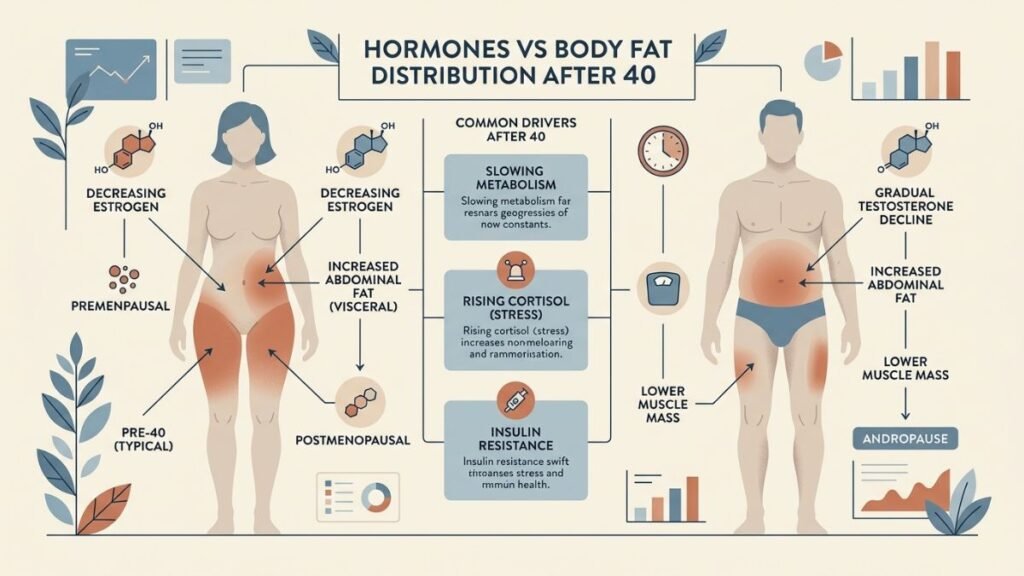
Perimenopause — the transitional years leading up to menopause — typically begins in a woman’s mid-to-late 40s, though it can start as early as the late 30s for some women. During this period, estrogen and progesterone levels fluctuate erratically before gradually declining.
Estrogen plays a direct role in fat distribution. When estrogen levels drop, the body tends to redirect fat storage away from the hips and thighs — the pattern typical of younger women — toward the abdomen. This is why many women in their 40s describe a sudden change in where their weight settles, even when the total amount hasn’t changed dramatically.
Beyond fat distribution, lower estrogen also affects insulin sensitivity. Your body becomes less efficient at managing blood sugar, which makes it easier to gain weight and meaningfully harder to lose it.
For Men: Testosterone Decline and What It Means
Men undergo their own hormonal transition — sometimes called andropause, though the term is less established medically. Testosterone levels in men decline at roughly 1 to 2 percent per year after age 30, and by the mid-40s, this accumulation can be clinically significant.
Testosterone is essential for building and maintaining muscle mass. As levels decline, the body becomes progressively less efficient at muscle retention — which, as we’ve established, directly reduces metabolic capacity and promotes fat accumulation, particularly around the abdomen.
Low testosterone is also associated with fatigue, reduced motivation to exercise, and mood changes — a compounding effect that makes the problem self-reinforcing.
Cortisol: The Weight Gain Driver Most People Miss
Cortisol, your body’s primary stress hormone, deserves its own chapter in this conversation. Chronic elevation of cortisol — which is extraordinarily common in high-demand, high-responsibility midlife adults — tells your body to store fat, and specifically to store it in the visceral (deep abdominal) region where it carries the most metabolic risk.
Elevated cortisol also triggers potent cravings for high-calorie, high-sugar, high-fat foods — not as a character flaw, but as a direct neurobiological response to stress. If your 40s have brought career pressure, family demands, financial stress, or sandwich-generation caregiving — and whose haven’t? — cortisol may be working against your weight management efforts continuously, even while you sleep.
Attention: If you suspect hormonal changes are contributing to your weight gain, a targeted blood panel can reveal a great deal. Ask your doctor about testing estrogen or testosterone (depending on your sex), progesterone, cortisol, and thyroid function. These are routine, relatively affordable tests — and the results can completely reframe your approach.

Sarcopenia: The Silent Reshaping of Your Body
We’ve referenced sarcopenia — age-related muscle loss — several times already, but it deserves a dedicated section because it is one of the most underappreciated and yet most actionable explanations for unexplained weight gain after 40.
Sarcopenia is not a disease. It is a normal biological process that begins in your 30s, accelerates in your 40s and 50s, and continues progressively unless it is deliberately countered. The American College of Sports Medicine estimates that adults who do not actively engage in resistance training lose approximately 6 pounds of muscle per decade from midlife onward.
The Confusing Part: The Scale May Not Tell the Full Story
Here’s what makes sarcopenic weight changes particularly hard to track: you can be gaining fat and losing muscle simultaneously in a way that barely registers on the scale — yet dramatically changes how your body looks, feels, and functions.
Researchers have identified a condition called sarcopenic obesity — where fat mass increases as muscle mass decreases, often without a dramatic change in total body weight. Many adults who report that they “only gained 8 pounds” in their 40s are actually experiencing a much larger shift in body composition: they may have lost 12 pounds of muscle and gained 20 pounds of fat, with the net scale change appearing modest.
The Good News: This Is Directly Reversible
The research is clear and genuinely encouraging here. Progressive resistance training — exercises that challenge your muscles with gradually increasing load — is the single most effective intervention for preserving and rebuilding muscle mass at any age, including midlife and beyond.
A well-designed strength training program, combined with adequate protein intake, can meaningfully reverse sarcopenic changes even in adults in their 50s and 60s. You do not need to start from a place of peak fitness or prior athletic experience. You need consistency and progressive challenge.
Sleep, Stress, and the Weight Connection After 40
Ask adults in their 40s how they’re sleeping, and the answers follow a strikingly consistent pattern: not well. Falling asleep takes longer. Staying asleep is harder. Waking up feeling genuinely rested feels like a memory from a different decade.
What most people don’t realize is that disrupted sleep is one of the most physiologically direct drivers of weight gain — and its impact intensifies after 40.
The Hormonal Mechanics of Sleep and Weight
While you sleep, your body regulates two hormones with direct influence over appetite and food intake: leptin, which signals fullness and satiety, and ghrelin, which signals hunger and drives food-seeking behavior.
Even a single night of inadequate sleep measurably suppresses leptin and elevates ghrelin — meaning you wake up biologically hungrier, feel less satisfied after eating, and are measurably more likely to reach for calorie-dense foods throughout the day. This is not a matter of willpower; it is a biochemical consequence of sleep deprivation.
A study published in the Annals of Internal Medicine found that sleep-restricted individuals on a calorie-restricted diet lost significantly less fat and substantially more muscle than those who slept adequately. In other words, poor sleep doesn’t merely make weight loss harder — it changes the composition of what weight you lose, shifting losses away from fat and toward the muscle you most need to keep.
Why Sleep Worsens After 40
Sleep disruption in midlife is compounded by several factors that act simultaneously: hormonal changes (declining progesterone in women is directly linked to worse sleep architecture), increased life stress, greater prevalence of sleep-disordered breathing (including sleep apnea, which often goes undiagnosed), and age-related changes in circadian rhythm regulation.
If you’re sleeping fewer than seven hours regularly, or sleeping seven hours but waking up consistently unrefreshed, this is a health issue worth addressing directly — not a lifestyle inconvenience worth accepting.
Best Practice: Treating sleep as a metabolic intervention — not a luxury — is one of the most evidence-supported changes you can make for weight management after 40. Seven to nine hours of quality sleep per night supports leptin-ghrelin balance, cortisol regulation, and muscle protein synthesis simultaneously.
Hidden Medical Causes Worth Investigating
Sometimes the word “unexplained” in unexplained weight gain has a very specific medical answer — one that no amount of dietary adjustment or exercise will correct until it’s identified and treated. If lifestyle factors are reasonably in order and weight gain persists, these conditions deserve serious consideration.
Hypothyroidism: The Great Impersonator
Your thyroid gland produces hormones that regulate the pace of virtually every metabolic process in your body. When the thyroid underperforms — a condition called hypothyroidism — everything slows: your heart rate, your digestion, your energy production, and your calorie-burning capacity.
Hypothyroidism is significantly more common in adults over 40, and particularly in women. According to the American Thyroid Association, approximately 20 million Americans have some form of thyroid disease, and up to 60 percent are unaware of their condition.
Symptoms frequently accompanying the weight gain include persistent fatigue that sleep doesn’t resolve, unusual sensitivity to cold, dry skin, constipation, thinning hair, and cognitive sluggishness (often described as brain fog). A TSH (thyroid-stimulating hormone) blood test can screen for this condition, and if hypothyroidism is identified, treatment with thyroid hormone replacement is typically highly effective.
Insulin Resistance
Insulin is the hormone that allows your cells to absorb glucose from the bloodstream for energy. When cells become progressively resistant to insulin’s signal — a state called insulin resistance — glucose accumulates in the blood, and your body compensates by producing increasing amounts of insulin.
Chronically elevated insulin levels have a direct fat-storage effect, particularly promoting visceral (abdominal) fat accumulation. Insulin resistance often develops silently over years before progressing toward pre-diabetes or Type 2 diabetes — and it is increasingly common in midlife adults, including those who have never had blood sugar concerns in the past.
A fasting glucose test and an HbA1c (hemoglobin A1c) test provide useful information about blood sugar regulation. A fasting insulin level test is even more informative for identifying early insulin resistance before it appears in standard glucose tests.
Medications That Promote Weight Gain
This factor is frequently overlooked in clinical conversations, but it matters: certain commonly prescribed medications can cause meaningful weight gain as a recognized side effect. These include several classes of antidepressants (particularly paroxetine and mirtazapine), corticosteroids such as prednisone, some beta-blockers used for blood pressure management, certain antihistamines, and paradoxically, some diabetes medications.
If weight changes began or accelerated around the time you started a new medication, this connection is worth discussing explicitly with your prescribing physician. Never discontinue or modify a medication without medical guidance — but do raise the conversation.
Your Diet May Not Have Changed — But Your Body’s Requirements Have
One of the most disorienting aspects of weight gain after 40 is that it can happen in the apparent absence of any dietary change. Same foods. Similar portions. Similar timing. And yet the body responds differently.
The explanation is a shift in the relationship between your intake and your body’s changing requirements — in two directions simultaneously.
Caloric Needs Decrease; Nutritional Needs Do Not
As muscle mass declines and metabolic activity adjusts, the number of calories your body requires to maintain its current weight gradually decreases. Research suggests this reduction may be in the range of 150 to 200 calories per decade after age 30 — a modest daily change that nonetheless compounds meaningfully over years.
A diet that perfectly maintained your weight at 37 may now create a consistent daily surplus at 47, not because you are eating more, but because your body needs less energy to perform the same functions.
Importantly, this does not mean severe caloric restriction is the answer — particularly not after 40, when that approach tends to accelerate muscle loss. The more useful response is a focus on food quality: maximizing protein, fiber, and micronutrient density per calorie, rather than simply reducing overall quantity.
The Gut Microbiome Factor
Emerging and rapidly expanding research suggests that changes in the gut microbiome — the community of trillions of bacteria residing in your digestive tract — may contribute to weight management challenges after 40.
The diversity of the gut microbiome tends to decrease with age. Certain bacterial profiles are associated with more efficient calorie extraction from food, altered fat storage signals, and broader metabolic disruption. While this field is still developing and specific recommendations are premature, the research consistently points toward the value of a varied, fiber-rich diet as a foundation for microbiome health.
Foods associated with a healthier microbiome include fermented foods (yogurt, kefir, kimchi, sauerkraut), legumes, whole grains, and a diverse array of vegetables and fruits. These same foods also tend to support blood sugar regulation and satiety — making their promotion well-supported regardless of where the microbiome science ultimately lands.

What You Can Actually Do About It
Everything discussed above points toward one central truth: the changes driving weight gain after 40 are real, biological, and not a reflection of personal failure. But they are also not a life sentence. Here is what the evidence genuinely supports.
Make Strength Training a Non-Negotiable
For adults over 40 navigating unexplained weight gain, cardiovascular exercise alone is not the answer — though it remains valuable for cardiovascular health. The more direct intervention for the underlying problem is progressive resistance training.
Two to three sessions per week, progressively increasing load or difficulty over time, has been shown to preserve and rebuild muscle mass, increase resting metabolic rate, improve insulin sensitivity, support hormonal health, and reduce visceral fat. For adults new to strength training, bodyweight exercises — squats, lunges, push-ups, rows, hip hinges — are an accessible and effective starting point.
Increase Protein Intake Deliberately
Most adults over 40 significantly undereat protein — and the consequences for body composition are substantial. Current research supports a target of 1.2 to 1.6 grams of protein per kilogram of body weight per day for adults in midlife and beyond. For a 160-pound adult, that translates to approximately 87 to 116 grams per day.
High-quality protein sources to prioritize include eggs, fish, lean poultry, Greek yogurt, cottage cheese, legumes, tofu, and whey or plant-based protein supplements if whole food sources are insufficient. Distributing protein across meals — rather than concentrating it at dinner — appears to optimize muscle protein synthesis throughout the day.
If you want to understand the full picture of what affects your metabolism at this stage of life, the article How to Boost Metabolism After 40 goes deeper into the specific dietary and lifestyle levers available to you.
Address Sleep as a Medical Priority
If you are sleeping fewer than seven hours consistently or waking up chronically unrefreshed, treat this as a clinical issue rather than a lifestyle inconvenience. Discuss sleep quality with your doctor. Ask about screening for sleep apnea if you snore or experience excessive daytime sleepiness. Protect your sleep environment: consistent bedtime, cool and dark room, minimal screen exposure in the final hour before sleep.
Build Active Stress Recovery Into Your Routine
Stress management after 40 is not about eliminating pressure — it is about creating deliberate recovery windows that allow your cortisol to return to baseline regularly. Evidence-supported approaches include mindfulness meditation (even ten minutes daily produces measurable cortisol reduction), consistent moderate exercise, time outdoors in natural light, and prioritizing social connection.
Push for Comprehensive Blood Work
If you’ve made good-faith efforts to address diet, movement, sleep, and stress — and unexplained weight gain continues — you are entitled to a thorough metabolic investigation. Request a comprehensive panel that includes: thyroid function (TSH, free T3, free T4), fasting glucose and HbA1c, fasting insulin, sex hormones (estradiol and progesterone for women; total and free testosterone for men), and a cortisol assessment.
These tests are routine, covered by most insurance plans, and can identify causes that lifestyle changes alone cannot address.

Closing Thoughts
Weight gain after 40 is rarely — almost never — a willpower problem. It is a biology problem. A real, measurable shift in how your hormones communicate, how your muscles respond, how your metabolism operates, and how your body distributes energy.
Understanding that truth changes everything. It shifts the question from “what am I doing wrong?” to “what is actually happening, and what does my body need now?” Those are questions with real, evidence-based answers.
Start with one change this week. Add a strength training session. Add a serving of protein at breakfast. Protect your sleep the way you’d protect any other health appointment. And if the weight persists despite your best efforts, bring this conversation to your doctor with the specific testing requests outlined above.
Your body has not turned against you. It is working differently. And working with those differences — rather than fighting them with strategies designed for a younger version of you — is exactly how you take back control.
Frequently Asked Questions About Why Am I Gaining Weight With No Reason Over 40?
Why am I gaining weight so fast after 40 when nothing in my diet has changed?
Several biological factors converge in midlife to create this experience. Gradual muscle loss reduces your resting calorie-burning capacity even without activity changes. Hormonal shifts — declining estrogen in women, declining testosterone in men — alter both fat distribution and metabolic efficiency. And because your body’s caloric needs decrease with age, an intake that was perfectly calibrated at 37 may now create a modest but consistent surplus at 45. These effects compound quietly over time until they cross a perceptible threshold.
Can unexplained weight gain after 40 be reversed?
Yes, and the research is genuinely encouraging. Adults who begin progressive strength training in midlife, increase protein intake, optimize sleep, and address any underlying hormonal or metabolic conditions consistently improve their body composition — often significantly. “Reversed” may be less useful framing than “effectively managed with the right tools”: sustainable improvements in body composition are realistic and well-supported by evidence at any age after 40.
Is belly fat after 40 a health risk, or just cosmetic?
Visceral fat — the type that accumulates deep in the abdominal cavity around the organs — carries genuine metabolic risk, including associations with cardiovascular disease, insulin resistance, Type 2 diabetes, and certain inflammatory conditions. This is distinct from subcutaneous fat (the softer layer just beneath the skin). If significant abdominal weight gain has occurred, it’s worth raising with your doctor both for potential underlying causes and for longer-term health monitoring.
Should I cut my calories dramatically to address weight gain after 40?
Severe caloric restriction is generally not recommended for adults over 40 without medical supervision. Aggressive restriction tends to accelerate muscle loss — the opposite of what’s needed — and can suppress metabolic rate further over time. A modest, sustainable reduction of 200 to 300 calories below your maintenance intake, combined with significantly higher protein and regular strength training, tends to produce better long-term body composition outcomes with far less biological cost.
Could my thyroid be the reason I’m gaining weight for no apparent reason?
Hypothyroidism is a legitimate, common, and frequently undiagnosed cause of unexplained weight gain in adults over 40 — particularly in women. Associated symptoms often include persistent fatigue, unusual cold sensitivity, dry skin, hair thinning, constipation, and mental fogginess. A TSH blood test is a simple and routine screening tool. If you haven’t had thyroid function tested recently, requesting this test is a reasonable first step.
How much protein should I be eating after 40 to protect my body composition?
Current research supports a target of 1.2 to 1.6 grams of protein per kilogram of body weight per day for adults in midlife — notably higher than general adult recommendations. For a 150-pound adult, this translates to roughly 82 to 109 grams of protein daily. Spreading protein across meals rather than concentrating it at dinner appears to optimize how effectively the body uses it for muscle maintenance.
What type of exercise works best for weight management after 40?
The most evidence-supported approach combines progressive resistance training (two to three times weekly, focused on major muscle groups) with regular moderate cardiovascular activity. Strength training directly addresses the muscle loss underlying most unexplained weight gain, while cardiovascular exercise supports heart health, insulin sensitivity, and overall energy balance. High-intensity interval training can be effective as well, but is best introduced gradually for those unaccustomed to high-intensity work. Consistency over years matters far more than perfection in any given week.