


Best Blood Sugar Supplement for Women Over 50: What Most Labels Won’t Tell You
If you’ve been searching for the best blood sugar supplement for women over 50, you’ve probably already noticed something frustrating: every product looks the same on the surface. Chromium. Berberine. Cinnamon extract. The labels all promise balance, stability, and steady energy — and yet so many women report buying supplement after supplement and still feeling the same afternoon crashes, the same sugar cravings, the same stubborn weight that seemed to arrive overnight and refuses to leave.
The problem isn’t the ingredients. The problem is knowing what to actually look for — and understanding why blood sugar regulation after 50 is a fundamentally different challenge than it was at 35.
Medical Disclaimer: This article is intended for informational and educational purposes only. It does not substitute professional medical advice, diagnosis, or treatment. Always consult a licensed healthcare provider before starting any supplement, especially if you manage a chronic condition or take prescription medications.
Why Blood Sugar Becomes Harder to Manage After Menopause
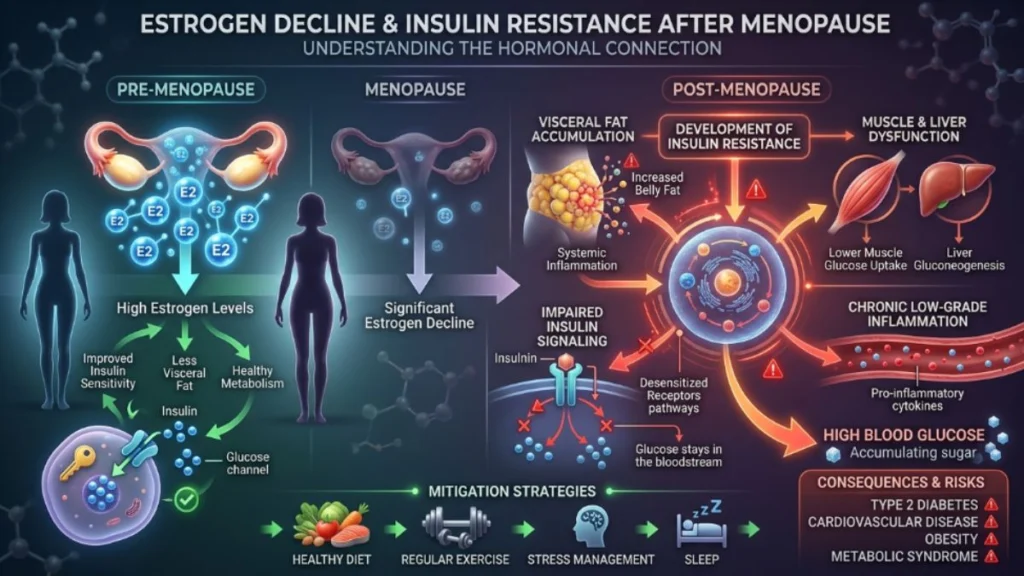
Most conversations about blood sugar focus on diet and exercise — which are absolutely important. But they skip over a central biological shift that affects virtually every woman after 50: the sharp decline in estrogen.
Estrogen does far more than regulate the reproductive cycle. It plays a direct role in insulin sensitivity. When estrogen levels drop during perimenopause and menopause, cells become measurably less responsive to insulin — meaning glucose stays in the bloodstream longer, energy becomes erratic, and fat accumulates differently, particularly around the abdomen.
According to research published by the National Institute of Diabetes and Digestive and Kidney Diseases, women’s risk of developing insulin resistance increases significantly after menopause, independent of diet or weight. This is not a personal failure. It is a hormonal reality that most supplement labels completely ignore.
The implication is practical: a supplement designed for general blood sugar support is not the same as one calibrated for the specific metabolic environment of a post-menopausal woman. When you understand this, you stop looking at chromium content alone and start asking much better questions.
Blood sugar stability and metabolic rate are deeply connected — understanding what happens to your metabolism after 40 helps explain why glucose regulation becomes a different challenge entirely after menopause.
The 4 Criteria That Actually Matter
Before you evaluate any specific product, build your checklist around these four factors. Most women skip straight to ingredient lists — and that’s where the marketing wins and the results disappoint.
1. Does It Address Insulin Sensitivity, Not Just Glucose Numbers?
There’s a meaningful difference between a supplement that lowers blood glucose acutely and one that improves the body’s response to insulin over time. For women over 50, the second matters far more.
Compounds with the strongest evidence for improving insulin sensitivity include berberine (studied at doses of 500mg, three times daily, with outcomes comparable to metformin in some trials), inositol (particularly the myo-inositol form, at 2–4g daily), and alpha-lipoic acid (600–1200mg daily). Look for these on the label — and look for their actual dosages, not just their presence.
A product that lists berberine without stating the amount is a red flag. Proprietary blends can hide clinically irrelevant doses behind impressive-sounding ingredient lists.
2. Does It Support Cortisol Regulation?
Chronic stress elevates cortisol, and cortisol directly raises blood glucose by triggering the liver to release stored sugar. Women over 50 often carry higher baseline cortisol due to sleep disruption, life transitions, and the physiological stress of hormonal change itself.
Adaptogens like ashwagandha (300–600mg of KSM-66 extract standardized to 5% withanolides) and rhodiola rosea have documented effects on cortisol modulation. Their inclusion in a blood sugar supplement is not a gimmick — it reflects a more complete understanding of what’s driving glucose instability in this population.
3. Is the Chromium Form Bioavailable?
Chromium polynicotinate and chromium picolinate are not equivalent. Picolinate has stronger clinical support for absorption and glucose metabolism. Standard effective doses range from 200–1000mcg daily. If a label says “chromium” without specifying the form, that is worth questioning.
4. Does It Include Digestive Support?
This one surprises most people. The gut microbiome has a direct, documented relationship with blood sugar regulation. Certain bacterial strains — particularly Lactobacillus acidophilus and Bifidobacterium longum — influence how glucose is processed after meals. A well-formulated blood sugar supplement for women over 50 may include digestive enzymes or probiotic support for this reason.

What the Research Says About Cinnamon (And Why the Form Matters)
Cinnamon is one of the most marketed ingredients in blood sugar supplements — and it genuinely earns its place, with caveats. The compound responsible for its metabolic effects is called MHCP (methylhydroxychalcone polymer), which improves insulin signaling at the cellular level.
The critical detail: Ceylon cinnamon (Cinnamomum verum) and Cassia cinnamon are not interchangeable. Cassia contains coumarin, which in high doses can stress the liver. For long-term daily supplementation, Ceylon is the appropriate form. If a product simply lists “cinnamon bark extract” without specifying the species, it is likely Cassia.
Effective doses studied range from 120mg to 6g daily, with most research clustering around 1–3g. This context matters when you’re reading a label that lists cinnamon at 50mg — it may simply be too low to replicate the outcomes in the research.
The Supplement Most Women in This Category Are Turning To
Affiliate Disclosure: This article contains affiliate links. If you click through and make a purchase, Sowing Healthy may earn a small commission — at no extra cost to you. We only recommend products we have genuinely researched and believe may offer value to our readers. Our editorial opinions are always our own.
Understanding what to look for is the first step. The second is finding a product that actually applies these criteria consistently.
One of the more complete formulations available for women navigating blood sugar stability after 50 addresses exactly these criteria — combining insulin-sensitizing compounds, adaptogenic support, and nutrients that reflect the hormonal component most products overlook. If you want to examine the full ingredient breakdown, this formulation is worth a closer look.
What stands out is the transparency around dosages and the combination of ingredients that separately have clinical backing: eleuthero for cortisol modulation, coleus forskohlii for metabolic support, maca root for hormonal balance, and African mango for appetite regulation and glucose response. These are not random additions — they form a coherent approach to the multi-factor challenge of blood sugar stability after menopause.
This is not a medical recommendation. Individual results vary, and no supplement replaces the guidance of a healthcare provider. But for women who have done the research, asked the right questions, and want a formulation that reflects more than generic glucose support, it is worth examining closely.

Three Mistakes That Make Any Supplement Less Effective
Even the best-formulated product will underperform if these common patterns are in play.
Taking it inconsistently. Blood sugar supplements work through cumulative mechanisms — improved insulin receptor sensitivity, reduced inflammatory markers, gradual microbiome shifts. Most require 4–8 weeks of consistent daily use before measurable changes appear. Starting and stopping based on week-one results is one of the most common reasons women conclude that supplements “don’t work.”
Taking it without food context. Several key compounds — berberine especially — have significantly better absorption and tolerance when taken with meals. Chromium timing relative to carbohydrate intake also matters. Read the label carefully and match timing to the manufacturer’s protocol.
Expecting the supplement to compensate for high glycemic eating. This is important to say directly: no supplement can reliably stabilize blood sugar against a daily diet built around refined carbohydrates and added sugars. The research supporting ingredients like berberine was conducted alongside, not instead of, dietary management. Supplements amplify good habits; they don’t replace them.
What to Expect in the First 30, 60, and 90 Days
One of the more useful things you can do before starting any blood sugar supplement is set realistic, evidence-based expectations.
Days 1–30: Most women notice the subtler changes first — more consistent energy through the afternoon, reduced intensity of sugar cravings after meals, and slightly more stable mood. These are early signals that glucose regulation is improving. Dramatic changes in fasting glucose numbers are unlikely this early.
Days 30–60: If insulin sensitivity is improving, you may begin to see changes in body composition — particularly around the midsection — even without significant dietary changes. Sleep quality often improves during this window as well, which has downstream effects on cortisol and glucose regulation the following day.
Days 60–90: This is the window in which consistent users typically report the most significant and measurable changes. If you track fasting glucose or use a continuous glucose monitor, this is when pattern differences become clearest.
According to Harvard Health Publishing, managing blood glucose is one of the most impactful long-term strategies for healthy aging — with downstream effects on cognitive function, cardiovascular health, and energy maintenance. Viewing blood sugar support as a long-term strategy, rather than a short-term fix, changes both the expectations and the outcomes.

A Practical Checklist Before You Buy
Use this before purchasing any blood sugar supplement:
- Does it specify the form of chromium (picolinate or polynicotinate)?
- Does it list individual ingredient dosages, or hide them in a proprietary blend?
- Does it include at least one adaptogen for cortisol support?
- Is cinnamon listed as Ceylon (Cinnamomum verum) specifically?
- Does the manufacturer provide a satisfaction guarantee (a strong signal of confidence in the product)?
- Are there independent reviews from women specifically in the 50+ age range?
No product will check every box perfectly. But this checklist shifts the conversation from marketing language to functional criteria — and that shift alone will help you make a far better decision.
For women who have done the research and want a starting point that meets most of these criteria, this option has become one of the more trusted in this category for women navigating hormonal and metabolic changes after 50.
Medical Disclaimer - The information provided in this article is for educational purposes only and is not intended to serve as medical advice, diagnosis, or treatment. Results vary from person to person. If you have a medical condition, take prescription medications, or have concerns about your blood sugar levels, consult a licensed healthcare provider before starting any supplement.
If you want a broader view of which supplement categories have the strongest evidence for this age group, this overview of natural supplements for adults over 40 is a useful starting point before making any decision.
Conclusion
Finding the best blood sugar supplement for women over 50 is less about finding a magic ingredient and more about understanding your biology clearly enough to evaluate what you’re buying. After menopause, blood sugar regulation is influenced by estrogen decline, cortisol patterns, gut health, and metabolic rate shifts — none of which a single-ingredient product can fully address.
The women who get the best results from supplementation are the ones who ask better questions before they buy: about dosages, ingredient forms, hormonal context, and realistic timelines. That knowledge doesn’t make the decision for you — but it makes the decision far more informed.
Your body after 50 is not broken. It has different needs. Meeting those needs precisely is where the real results come from — and for women who want to start with a formulation built around those needs, the research points to some clear options worth exploring.
Frequently Asked Questions
Can a blood sugar supplement replace diabetes medication?
No. Blood sugar supplements are not medications and are not intended to treat, cure, or replace prescribed treatment for diabetes or prediabetes. They may support healthy glucose metabolism as part of a broader lifestyle approach, but any changes to medication should be managed exclusively by your healthcare provider.
How long does it take for a blood sugar supplement to work?
Most evidence-based supplements require consistent daily use for 30–90 days before measurable changes in insulin sensitivity or fasting glucose appear. Short-term effects — like reduced afternoon energy crashes or fewer cravings — may appear earlier, within the first two to three weeks.
Is berberine safe for women over 50?
Berberine is generally well-tolerated and has a strong evidence base for glucose and lipid metabolism. However, it can interact with certain medications, including blood pressure drugs and diabetes medications. Women on prescription medications should discuss berberine supplementation with their doctor before starting.
What’s the difference between blood sugar support and blood sugar control?
“Support” supplements work through gentle, cumulative mechanisms — improving insulin sensitivity, reducing post-meal spikes, supporting gut health. “Control” implies a therapeutic, medical intervention. Over-the-counter supplements fall into the support category and should be approached as complementary tools, not treatments.
Should I check my blood sugar before starting a supplement?
Getting a baseline fasting glucose reading before starting any supplementation is a practical idea — it gives you a measurable reference point for tracking progress. This can be done with an affordable home glucometer or during a routine blood panel with your doctor.
Are blood sugar supplements safe to take long-term?
For most healthy adults, well-formulated supplements with evidence-backed ingredients at appropriate dosages are safe for long-term use. The key variables are ingredient quality, dosage, and individual health context. Periodic check-ins with your healthcare provider are advisable, particularly if you’re managing any chronic condition.
Does stress really affect blood sugar in women over 50?
Significantly. Cortisol — the primary stress hormone — directly triggers the liver to release stored glucose into the bloodstream. For women over 50, who often face elevated baseline cortisol from disrupted sleep, hormonal changes, and life transitions, stress management is not separate from blood sugar management. It is part of it.

Sarah Mitchell is a health and wellness writer specializing in longevity, natural supplementation, and healthy aging for adults over 40. With a background in nutrition sciences and years of research into evidence-based approaches to long-term well-being, she founded Sowing Healthy to provide honest, research-grounded guidance for people navigating the health changes that come with midlife. Sarah believes that good health is built gradually — through the right information, consistent habits, and supplements that actually earn their place.