

Digestive Enzymes After 50: What Your Gut Really Needs
If you’ve started wondering whether digestive enzymes after 50 are the missing piece to feeling comfortable after meals, you’re asking a smarter question than most of the internet wants you to. Maybe the same dinner that never bothered you at 40 now leaves you bloated and heavy. Maybe a slice of cheese or a bowl of beans sits like a brick for hours. You’re not imagining it, and you’re not being dramatic.
Here’s something rarely said out loud: research suggests our digestive function genuinely shifts with age. The body’s output of enzymes and stomach acid can taper off gradually, which is part of why a stomach that once handled anything now sends complaints after meals it used to love.
This article will walk you through what digestive enzymes actually do, who genuinely benefits from supplementing after 50 (and who honestly doesn’t), what real science says, and how to tell a trustworthy product from a marketing trap. By the end, you’ll be able to make this decision with clear eyes instead of clever advertising.
This guide to digestive enzymes after 50 is for informational and educational purposes only. It does not constitute medical advice. Please consult your healthcare provider before making changes to your diet, supplements, or health routine.
What Digestive Enzymes Actually Do
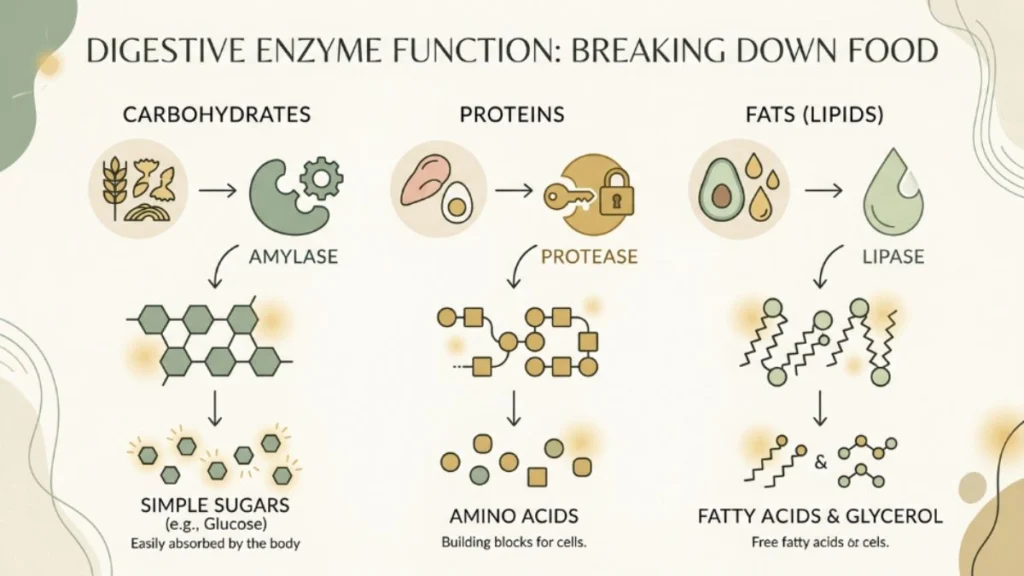
Digestive enzymes are proteins your body makes to break food down into pieces small enough to absorb. Your saliva, stomach, pancreas, and small intestine each release their own, and they work like specialized keys. Amylase breaks down carbohydrates. Protease handles proteins. Lipase tackles fats. Lactase splits the sugar in dairy. When these are working well, you barely notice digestion happening at all.
When they fall short, you notice everything. Food lingers, ferments, and produces gas. You feel full long after you should. This is the quiet machinery behind so much post-meal discomfort, and it’s why the conversation around digestive enzymes after 50 keeps growing.
Why Things Change After 50

Aging affects digestion through several overlapping shifts, and understanding them takes the mystery out of your symptoms.
Stomach acid production tends to decline with age, and that acid is what activates certain enzymes and signals the pancreas to release its own. Pancreatic enzyme output can gradually decrease as well. On top of that, lactose intolerance becomes far more common after midlife, as the body produces less lactase than it did in childhood.
None of this means your digestion is broken. It means it’s changed, and it may need a little more support than it used to. That’s a very different message from the fear-based marketing you’ll see elsewhere.
A real-life scenario
One reader described it perfectly: she’d eaten a small bowl of lentil soup every week for twenty years. Suddenly, in her mid-fifties, that same soup left her bloated and uncomfortable until bedtime. Nothing about the soup changed. What changed was her body’s ability to break down the complex carbohydrates in those legumes. Her experience is textbook, and it’s the kind of shift enzymes are sometimes used to address.
What the Science Actually Says
This is where honesty matters most, because the supplement industry tends to overpromise here.
The strongest evidence is for specific, well-defined situations. Lactase, taken with dairy, reliably helps people who don’t produce enough of it on their own. That one isn’t controversial.
For broader post-meal discomfort, the evidence is promising but more limited. In a randomized, double-blind, placebo-controlled study, a multi-enzyme supplement significantly reduced bloating, gas, and feelings of fullness in people with functional dyspepsia compared to placebo. In another controlled study, acid-resistant lipase taken before a high-fat meal measurably lowered the stomach fullness that fatty meals can trigger. These are real, measured outcomes, not testimonials.
It’s also worth knowing that laboratory research modeling “digestive senescence” — the natural decline in digestion that comes with age — found that added enzymes improved the breakdown of nutrients from a mixed meal. That’s exactly the population this article is for.
But here is the counterweight every honest guide owes you: most healthy people who eat a balanced diet make all the enzymes they need. Medical experts are clear that digestive enzymes are not a cure-all, and the body’s own enzymes work best alongside whole foods. If you’re generally fine and only occasionally uncomfortable, food and habits may matter more than any capsule.
How to Choose a Trustworthy Enzyme Supplement

If you and your healthcare provider decide an enzyme product is worth trying, this is the part that protects both your wallet and your health. Most products on the shelf fail at least one of these tests.
Affiliate Disclosure: This article contains affiliate links. If you click through and make a purchase, Sowing Healthy may earn a small commission — at no extra cost to you. We only recommend products we have genuinely researched and believe may offer value to our readers. Our editorial opinions are always our own.
Look for activity units, not just milligrams. This is the single most important rule, and almost nobody mentions it. Enzymes are measured by how active they are, not how much they weigh. A label that says “amylase 24,000 DU” or “lipase 3,000 FIP” is telling you something real. A label that lists only “500 mg enzyme blend” is telling you almost nothing. If you find a broad-spectrum enzyme formula that lists the activity units for every enzyme it contains, you’re already ahead of most shoppers.
Insist on named enzymes. You want to see amylase, protease, lipase, lactase, cellulase, alpha-galactosidase, and so on, spelled out individually. Vague “digestive support complex” wording is a red flag.
Demand third-party testing and clean manufacturing. Supplements aren’t pre-approved by the FDA, so the credible signal is a product made in a GMP-certified, FDA-registered facility and verified by an independent lab. A transparent, third-party-tested formula from a brand trusted by health practitioners carries far more weight than a flashy bottle with bold claims.
Walk away from anything that mentions weight loss. Enzymes marketed to “melt fat” or “flatten your belly” are exploiting hope, not science. There’s no credible evidence that digestive enzymes cause weight loss, and that single claim should send you in the other direction.
Green flags vs. red flags
| Trustworthy sign | Marketing trap |
|---|---|
| Activity units listed (DU, HUT, FIP, ALU) | Only milligrams, or no units at all |
| Each enzyme named individually | Vague “proprietary digestive complex” |
| Third-party tested, GMP-certified facility | No testing mentioned, bold guarantees |
| Honest, modest claims | “Melts fat,” “cures bloating forever” |
| Clear dosing with meals | Pressure-filled countdown timers |
How and When to Take Them
Timing changes everything. Digestive enzymes are meant to work with food, so they’re typically taken right before or at the start of a meal — that’s when the food they need to break down is arriving. Taking them on an empty stomach hours later does little for digestion.
Start with the meals that bother you most. If dairy is your trigger, you may only need enzyme support at those specific meals rather than every time you eat. Pay attention, adjust, and keep expectations realistic: a supportive tool can ease discomfort, but it won’t undo a meal your body simply isn’t ready for.
When Discomfort Needs a Doctor, Not a Supplement
This matters enormously, so please don’t skim it. Digestive enzymes are for ordinary, occasional, meal-related discomfort. They are not a substitute for medical care.
If you have persistent or worsening symptoms — ongoing pain, unexplained weight loss, blood in your stool, chronic diarrhea, difficulty swallowing, or symptoms that keep escalating — these deserve professional evaluation, not a capsule. True enzyme insufficiency, such as the kind seen with pancreatic conditions, is a medical diagnosis treated with prescription enzymes under a doctor’s care. Trust your instincts: if something feels wrong rather than just uncomfortable, see your healthcare provider.
Realistic Expectations

If you try a quality enzyme supplement for the right reasons, here’s what’s fair to expect. Many people notice less bloating and a lighter feeling after their trigger meals within a few days, because enzymes act on the meal in front of them rather than slowly building up over weeks.
What you should not expect is a personality change for your gut. Enzymes support digestion; they don’t rebuild it. They pair best with the slower, steadier habits that genuinely shift how you feel over time — the kind that don’t come in a bottle at all.
Conclusion
Choosing whether you need digestive enzymes after 50 doesn’t have to be confusing or fear-driven. Your digestion has simply changed, the way so much does in this season of life, and you now know what’s actually happening behind those uncomfortable meals.
You know the enzymes by name, you know who genuinely benefits, you know the green flags that separate honest products from hype, and you know the warning signs that call for a doctor instead. That’s real power. Whatever you decide, you’re approaching your health with the clarity you deserve — and that mindset will serve you long after this one question is answered.
Frequently Asked Questions
Do I really need digestive enzymes after 50?
Not necessarily. Many healthy people who eat a balanced diet make enough enzymes on their own. They’re most useful if you have specific triggers, like dairy or legumes, or consistent post-meal bloating. When in doubt, talk it through with your healthcare provider.
Can digestive enzymes help with bloating?
For some people, yes. Controlled studies have shown multi-enzyme supplements reducing bloating, gas, and fullness in people with meal-related discomfort. Results vary by individual, and they work best taken right before meals.
Are digestive enzymes safe to take every day?
For most people they’re generally well tolerated with meals, but daily long-term use is a good thing to review with your doctor, especially if you take medications or have a health condition. Safety also depends on choosing a clean, third-party-tested product.
Will digestive enzymes help me lose weight?
No. There’s no credible evidence that digestive enzymes cause weight loss, and any product promising that is a red flag. Their job is breaking down food for comfort and absorption, not burning fat.
When is the best time to take digestive enzymes?
Right before or at the start of a meal, since they work on the food as it arrives. Taking them long after eating, on an empty stomach, does little for digestion.
How do I know if an enzyme supplement is good quality?
Look for each enzyme named individually with its activity units listed (like DU, HUT, or FIP), third-party testing, and manufacturing in a GMP-certified facility. Avoid anything with weight-loss claims or vague “proprietary complex” labels.
Could my symptoms be something more serious?
Possibly. Enzymes are for ordinary, occasional discomfort. Persistent pain, unexplained weight loss, blood in the stool, or worsening symptoms always warrant a professional evaluation rather than a supplement.

Sarah Mitchell is a health and wellness writer specializing in longevity, natural supplementation, and healthy aging for adults over 40. With a background in nutrition sciences and years of research into evidence-based approaches to long-term well-being, she founded Sowing Healthy to provide honest, research-grounded guidance for people navigating the health changes that come with midlife. Sarah believes that good health is built gradually — through the right information, consistent habits, and supplements that actually earn their place.