


Natural Supplements for Adults Over 40: What Actually Works (and What to Skip)
This content is for informational and educational purposes only. It does not constitute medical advice. Please consult your healthcare provider before making changes to your diet, supplements, or health routine.
If you’ve been researching natural supplements for adults over 40, you already know the frustration — rows of bottles, conflicting advice, and bold claims that rarely hold up under scrutiny.
Here’s what most supplement articles won’t tell you: your body after 40 is not the same body you had at 25. The nutrients you can absorb, the hormonal environment your cells work in, and the deficiencies you’re most likely carrying — all of it shifts. A supplement strategy built for a college athlete will not serve a 52-year-old managing stress, sleep disruption, and a metabolism that seems to have quietly changed the rules.
What actually works isn’t complicated. But it is specific.
This guide will walk you through the most research-backed natural supplements for adults in the 40–65 age range — what each one does, what the science actually says, who benefits most, and how to build a sensible, sustainable stack. No hype. No miracle claims. Just the clearest picture we can give you.
Why Supplementation Becomes More Important After 40
Before diving into specific supplements, it’s worth understanding why this age range is when nutritional support starts to matter more — not less.
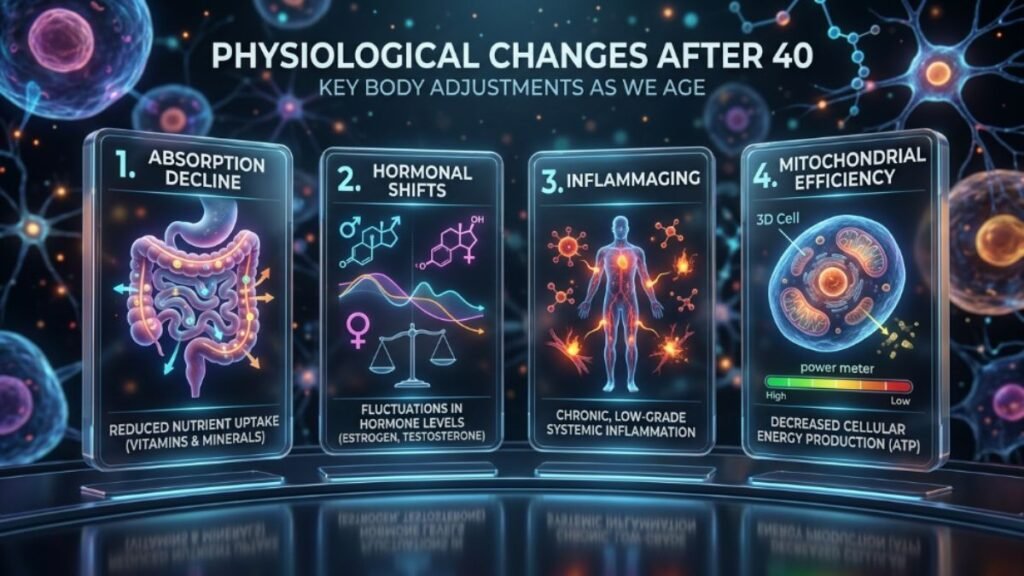
Several physiological shifts converge around the fourth decade of life:
Absorption declines. The gut’s ability to extract certain nutrients from food — particularly B12, magnesium, calcium, and zinc — decreases with age. You can be eating a perfectly balanced diet and still be functionally deficient.
Hormonal changes alter nutrient needs. Declining estrogen (in women approaching perimenopause) and testosterone (in men) alter how the body uses vitamin D, calcium, and protein. Hormonal shifts also affect sleep quality, which has cascading effects on virtually every metabolic process.
Chronic low-grade inflammation increases. Researchers call this “inflammaging” — the slow, systemic inflammation that accumulates with age and underlies many of the health concerns that emerge after 40: joint pain, brain fog, fatigue, metabolic dysfunction, and cardiovascular risk.
Mitochondrial efficiency drops. The cellular “engines” that produce energy become less efficient, partly due to declining CoQ10 levels and reduced NAD+ production. This is one of the core reasons energy levels shift after 40, independent of sleep or stress.
Understanding these mechanisms helps you choose supplements with intention rather than impulse.
The Non-Negotiables: Supplements Almost Every Adult Over 40 Should Consider
These are not trendy compounds. They are the nutritional foundations that research consistently shows are depleted, inadequately absorbed, or critically needed in adults navigating midlife.
Magnesium
Magnesium may be the single most impactful supplement for adults over 40 that most people are not taking seriously enough.
It’s involved in over 300 enzymatic reactions in the body — including energy production, protein synthesis, blood glucose regulation, muscle function, and nerve signaling. It’s also the primary activator of the parasympathetic nervous system, which is the biological mechanism behind rest, recovery, and sleep.
Studies estimate that up to 75% of American adults do not meet the recommended daily intake of magnesium. This number is higher in adults over 50, partly because absorption decreases and excretion increases with age, and partly because modern processed diets are naturally low in it.
The practical effects of magnesium insufficiency include poor sleep, muscle cramps, anxiety, elevated blood pressure, and irregular heartbeat. Many adults over 40 living with these symptoms are never told that their mineral levels may be contributing.
What form matters: Not all magnesium is equal. Magnesium glycinate and magnesium malate are the most bioavailable and best tolerated. Avoid magnesium oxide — it’s cheap and poorly absorbed, and most of it passes straight through.
Suggested intake: 300–400mg daily, taken in the evening for best sleep benefits.
Vitamin D3 + K2
Vitamin D deficiency is one of the most common nutritional deficiencies globally, and its prevalence increases sharply after 40. Despite being called a “vitamin,” D3 is actually a hormone precursor that influences immune regulation, calcium metabolism, mood, muscle strength, and cardiovascular function.
After 40, the skin’s ability to synthesize vitamin D from sunlight decreases by roughly 50% compared to younger adults. If you live at a northern latitude, work indoors, or consistently use sun protection (all sensible things), your baseline production is even lower.
The K2 pairing matters. Vitamin D facilitates calcium absorption, but it’s vitamin K2 that directs that calcium into bones and teeth rather than arterial walls. This combination — D3 + K2 — is now widely regarded as the more complete and safer approach to bone and cardiovascular health in adults over 40.
Suggested intake: 2,000–5,000 IU of D3 daily (ideally after a blood test to establish baseline); 100–200mcg of K2 (MK-7 form) alongside it.
KNOW MORE: Why Am I Always Tired at 40? Causes, Solutions, and What Actually Helps
Omega-3 Fatty Acids (EPA + DHA)
The research on omega-3 fatty acids is among the most robust in nutritional science. EPA and DHA — the active forms found in fatty fish and quality fish oil — have been consistently shown to support cardiovascular health, reduce systemic inflammation, protect cognitive function, support joint mobility, and improve mood regulation.
For adults over 40, the anti-inflammatory properties are particularly relevant. Chronic low-grade inflammation underlies joint pain, arterial stiffness, brain fog, and metabolic dysfunction — all of which become more common after midlife. Omega-3s are one of the most direct dietary levers for managing this.
A landmark meta-analysis published in the Journal of the American College of Cardiology found that high-dose omega-3 supplementation significantly reduced cardiovascular events in high-risk adults. Separate research has linked adequate DHA levels to reduced risk of cognitive decline in adults over 50.
What to look for: Choose a triglyceride-form fish oil with a combined EPA + DHA content of at least 1,000–2,000mg per serving. Enteric-coated capsules reduce fishy aftertaste. Algae-based omega-3 is an excellent plant-based alternative with equivalent DHA content.
Suggested intake: 1,000–3,000mg of combined EPA + DHA daily, taken with a meal containing fat.
B-Complex (Especially B12 and Folate)
The B vitamins are the backbone of energy metabolism — they’re required for converting food into ATP (cellular fuel), for synthesizing neurotransmitters, for producing red blood cells, and for maintaining the myelin sheaths that protect nerve fibers.
After 40, B12 absorption declines significantly because it requires a protein called intrinsic factor, which the stomach produces in decreasing quantities with age. By 50, roughly 30% of people have some degree of atrophic gastritis that impairs B12 absorption. The result is often subtle but real: fatigue, tingling in the extremities, brain fog, and mood instability.
Folate (B9) and B6 work alongside B12 in the methylation cycle, which regulates homocysteine — an amino acid that becomes damaging to arteries and the brain when elevated. Elevated homocysteine is a recognized independent risk factor for cardiovascular disease and cognitive decline, and B-vitamin supplementation is one of the primary interventions.
Important note: Look for methylated forms — methylcobalamin (B12) and methylfolate (B9). These are the active forms your body can use immediately, without requiring conversion. People with the common MTHFR gene variation cannot efficiently convert synthetic folic acid, making methylated folate especially important.

Coenzyme Q10 (CoQ10)
CoQ10 is a fat-soluble compound produced naturally by the body that plays a central role in mitochondrial energy production. It also functions as a potent antioxidant, protecting cell membranes from oxidative damage.
The problem: CoQ10 production declines steadily after age 30–35, and drops sharply in adults taking statins (cholesterol-lowering medications), which block the same pathway the body uses to make CoQ10. For adults over 40 on statins — a large and growing population — CoQ10 supplementation is especially important.
Beyond statin users, CoQ10 is relevant for anyone experiencing unexplained fatigue, cardiovascular concerns, or the kind of low-level energy depletion that doesn’t improve with sleep. Research published in Biofactors has also suggested CoQ10’s role in supporting blood pressure regulation and reducing oxidative stress in the aging cardiovascular system.
What form matters: Ubiquinol (the reduced form) is significantly more bioavailable than ubiquinone, particularly in adults over 40 whose ability to convert ubiquinone diminishes with age.
Suggested intake: 100–200mg of ubiquinol daily, taken with a meal containing fat.
Supplements for Specific Needs After 40
Beyond the non-negotiables above, some supplements become particularly valuable depending on your specific health priorities and challenges.
For Joint Health and Mobility
Joint discomfort is one of the most universally reported concerns after 40. Cartilage that once recovered overnight begins to wear more slowly, and the synovial fluid that lubricates joints decreases in quantity and quality.
Collagen peptides (Type II): Clinical studies show that hydrolyzed collagen supplementation can improve joint pain and function in adults with osteoarthritis and age-related joint wear. Type II collagen, specifically, has been shown to modulate the immune response that drives cartilage degradation.
Boswellia serrata: One of the most well-researched natural anti-inflammatories, with clinical evidence supporting its role in reducing joint pain and improving mobility — particularly in knee osteoarthritis — comparable in some studies to NSAIDs, but without gastrointestinal side effects.
Curcumin (with piperine): Turmeric’s active compound has strong anti-inflammatory properties, but bioavailability is notoriously poor. Formulations that include piperine (from black pepper) or use phospholipid complexes (like Meriva) significantly improve absorption and efficacy.
JOINT PAIN AFTER 40: Why It Happens and What Actually Helps
For Sleep Quality and Recovery
Sleep architecture changes dramatically after 40. Deep sleep — the most physically restorative phase — decreases in duration, and the consequences ripple through metabolism, cognition, immunity, and emotional regulation.
Magnesium glycinate (already mentioned above) is the first-line supplement for sleep support in this age group, due to its GABA-activating and cortisol-lowering properties.
Ashwagandha (Withania Somnifera): An adaptogenic herb with an excellent clinical evidence base for reducing cortisol, improving sleep quality, and supporting stress resilience. A 2019 randomized controlled trial in Cureus found significant improvements in sleep quality scores in participants taking 300mg twice daily for 10 weeks.
L-Theanine: The amino acid found in green tea that promotes relaxed, alpha-wave brain activity — particularly useful for adults whose difficulty sleeping stems from racing thoughts or elevated nighttime anxiety rather than circadian disruption.
Melatonin (low dose): Often overdosed in mainstream products. Research suggests 0.5–1mg is as effective as 5–10mg for most adults, with fewer side effects. Melatonin is most useful for circadian rhythm disruption (shift work, travel, irregular schedules) rather than as a primary sleep aid.
✅For a deep-dive into one of the more complete sleep and recovery supplements on the market right now, see our detailed – Renew supplement review
For Metabolism and Blood Sugar Balance
Metabolic rate naturally slows after 40, partly due to muscle mass loss (sarcopenia), partly due to hormonal shifts, and partly due to insulin sensitivity changes. Several natural compounds have meaningful research support in this area.
Berberine: One of the most clinically validated natural compounds for blood sugar regulation. Multiple studies have shown berberine activates AMPK — a cellular energy sensor sometimes called the “metabolic master switch” — with glucose-lowering effects comparable to metformin in some trials. It also supports healthy cholesterol and gut microbiome diversity.
Chromium picolinate: Enhances insulin sensitivity and supports healthy blood glucose metabolism. Particularly useful for adults with cravings, energy crashes after meals, or a family history of metabolic conditions.
Green tea extract (EGCG): Catechins from green tea have been shown to support fat oxidation, improve insulin sensitivity, and provide antioxidant protection. Most meaningful effects are seen at 400–500mg EGCG per day.

For Cognitive Health and Brain Protection
The brain is metabolically the most demanding organ in the body — and it’s also one of the most vulnerable to the effects of aging, inflammation, and oxidative stress. Cognitive protection is not something to wait until symptoms appear to address.
Lion’s Mane Mushroom: One of the most exciting areas in natural nootropics. Lion’s Mane contains compounds called hericenones and erinacines that have been shown in preliminary research to stimulate NGF (Nerve Growth Factor) — a protein critical for maintaining and regenerating neurons. A 2009 double-blind Japanese trial found significant improvements in cognitive function scores in older adults after 16 weeks of supplementation.
Phosphatidylserine: A phospholipid that makes up a significant portion of brain cell membranes. Supplementation has been studied for its role in supporting memory, cognitive speed, and stress response in aging adults. The FDA has acknowledged a qualified health claim linking phosphatidylserine to reduced risk of cognitive dysfunction.
Bacopa monnieri: An Ayurvedic herb with a solid evidence base for improving memory consolidation and reducing anxiety. Effects are gradual — most studies show meaningful results after 8–12 weeks of consistent use.
How to Build a Supplement Stack You’ll Actually Stick To
Having a list of 15 supplements is not a strategy. Here’s how to approach this practically:
Start with deficiencies, not trends. Before adding anything, consider getting a basic blood panel that includes vitamin D, B12, magnesium (RBC magnesium, not serum), and basic metabolic markers. This tells you what you actually need rather than what’s popular.
Prioritize by your top 2–3 health goals. If your primary concerns are energy and sleep, start with magnesium, D3/K2, and a B-complex. If joint mobility is the priority, lead with omega-3s, collagen, and boswellia. Don’t try to address everything at once.
Give each supplement a fair trial. Many natural compounds require 6–12 weeks of consistent use before meaningful effects are established. Adding five new supplements at once also makes it impossible to identify what’s working and what isn’t. Introduce one or two at a time.
Quality matters more than most people realize. The supplement industry is largely unregulated. Look for brands with NSF, USP, or Informed Sport third-party certifications, or products manufactured in FDA-approved, GMP-certified facilities. What’s on the label should match what’s in the capsule.
Timing is a real variable. Fat-soluble nutrients (D3, K2, CoQ10, omega-3s) are always better absorbed with a meal containing fat. Magnesium and sleep-support supplements work best in the evening. Energizing compounds (B-complex, green tea extract) are generally better taken in the morning.

What to Be Careful About
A guide this honest needs to include the cautions too.
More is not better. Fat-soluble vitamins (A, D, E, K) accumulate in the body and can reach toxic levels with chronic overconsumption. Even water-soluble nutrients have upper limits worth respecting. Follow evidence-based dosage guidance, not the highest dose available.
Interactions with medications are real. Omega-3s can affect anticoagulants. St. John’s Wort interferes with dozens of medications. CoQ10 can interact with blood thinners. 5-HTP (found in supplements like Renew) interacts with antidepressants. Always review your supplement list with your prescribing physician.
Supplements support health — they don’t replace it. No supplement compensates for chronic sleep deprivation, a diet built around ultra-processed foods, physical inactivity, or unmanaged stress. The most evidence-based approach to health after 40 is a foundation of lifestyle — and supplements layered thoughtfully on top of that foundation.
A Final Word on Navigating This at 40+
You deserve information that respects your intelligence and your lived experience. You’ve probably already tried things that didn’t work. You know your body better than any generic article can.
What this guide hopes to offer is a clearer framework: understand the mechanisms, prioritize by your actual needs, demand quality in what you put in your body, and give things enough time to work before drawing conclusions.
The supplements covered here are not exotic. They are the compounds that decades of research keep returning to as genuinely useful for the health challenges most common in this life stage. Start there. Be consistent. And check in with a healthcare provider who takes your goals seriously.
Your body after 40 is not in decline — it’s in a phase of life that responds remarkably well to the right inputs.
Frequently Asked Questions
What are the most important natural supplements for adults over 40?
The most consistently evidence-backed supplements for this age group are magnesium (glycinate or malate form), vitamin D3 paired with K2, omega-3 fatty acids (EPA + DHA), a B-complex with methylated B12 and folate, and CoQ10 (ubiquinol form). These address the most common deficiencies and physiological shifts that emerge after 40. Beyond this foundation, specific supplements can be layered based on your personal health goals.
Do supplements really make a difference after 40?
For many adults, yes — particularly because absorption decreases, hormonal changes alter nutrient metabolism, and modern diets often fail to deliver adequate levels of key micronutrients. That said, the evidence varies significantly between compounds. The supplements covered in this guide have the strongest research support for adults in the 40–65 age range. As always, individual results depend on baseline nutrient levels, lifestyle, and consistency of use.
Is it safe to take multiple supplements at the same time after 40?
A thoughtfully chosen combination of 3–5 supplements is generally considered safe for healthy adults. The risk increases when high doses of fat-soluble vitamins are combined, when supplements interact with prescription medications, or when products from unregulated sources are used. Working with a healthcare provider to identify your actual nutritional gaps and reviewing your full supplement list with your doctor or pharmacist is the safest approach.
How long does it take to feel results from natural supplements?
It depends entirely on the supplement and the individual. Magnesium often produces noticeable improvements in sleep and muscle tension within 1–2 weeks. Vitamin D levels take 8–12 weeks to meaningfully change in the bloodstream. Omega-3 effects on inflammation are typically seen after 6–8 weeks. Cognitive support compounds like Bacopa and Lion’s Mane require 8–12 weeks of consistent use. Setting realistic expectations and committing to a consistent trial period is essential.
Can natural supplements replace prescription medication after 40?
No. Natural supplements are not equivalent to prescription medications and should never be used to replace or discontinue prescribed treatment without medical guidance. Certain supplements can complement medical care — for example, CoQ10 alongside statin therapy, or berberine in early-stage metabolic management — but always in partnership with your healthcare provider, never as a substitute for it.
What should I look for when choosing supplement brands?
Third-party testing certifications are the most reliable signal of quality: NSF International, USP Verified, Informed Sport, or products manufactured in FDA-approved, GMP-certified facilities. These certifications confirm that the product contains what the label claims, at the stated dose, without harmful contaminants. Price alone is not a reliable quality indicator in either direction.
Do men and women over 40 need different supplements?
Some differences exist. Women approaching perimenopause benefit particularly from calcium with D3 and K2 (bone loss accelerates post-menopause), magnesium for hormonal mood support, and potentially phytoestrogens for vasomotor symptoms. Men over 40 may benefit from saw palmetto for prostate health and zinc for testosterone support. That said, the foundational supplements covered in this guide — omega-3s, D3/K2, magnesium, B-complex, CoQ10 — are valuable for both sexes in this age group.

Sarah Mitchell is a health and wellness writer specializing in longevity, natural supplementation, and healthy aging for adults over 40. With a background in nutrition sciences and years of research into evidence-based approaches to long-term well-being, she founded Sowing Healthy to provide honest, research-grounded guidance for people navigating the health changes that come with midlife. Sarah believes that good health is built gradually — through the right information, consistent habits, and supplements that actually earn their place.